
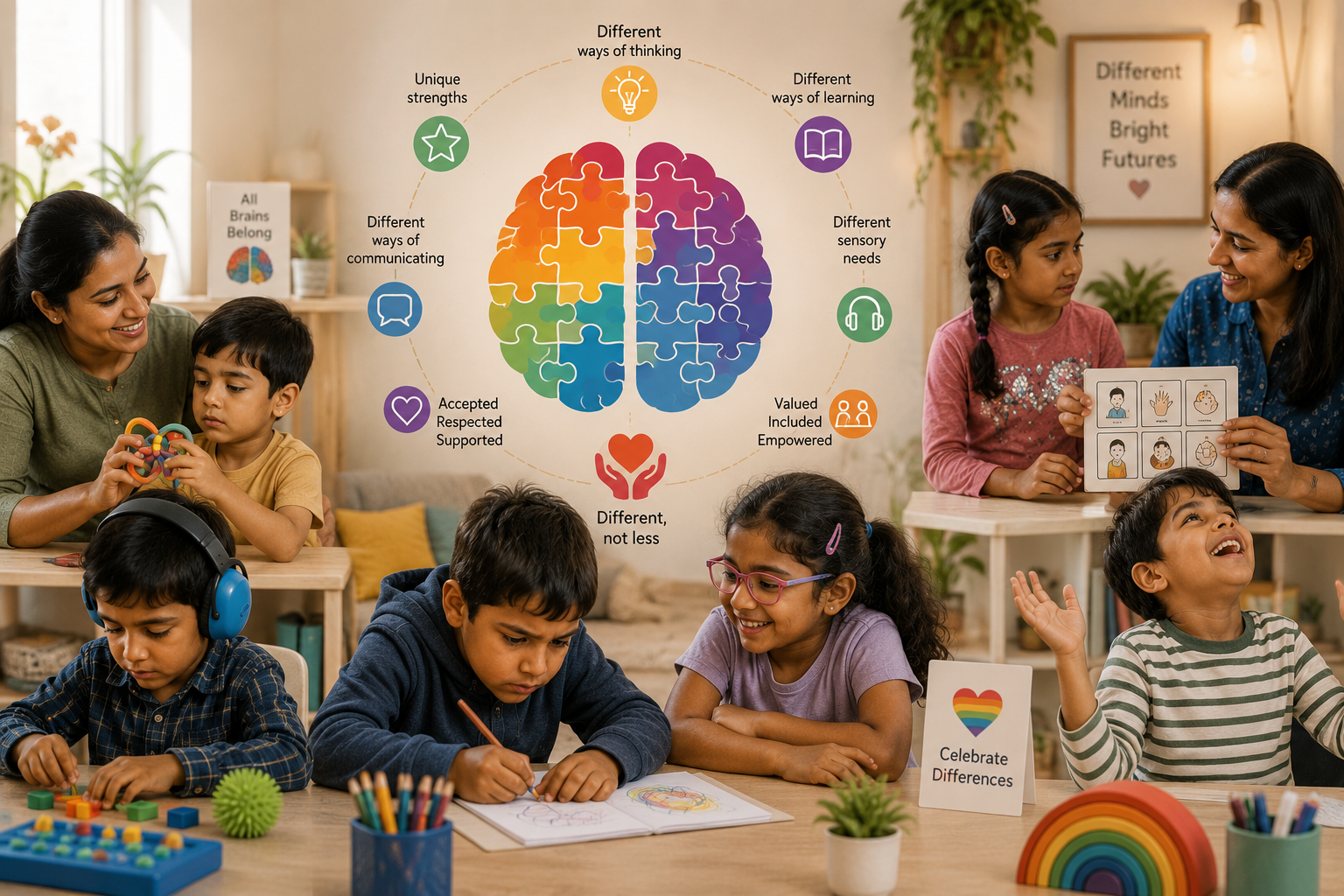
Every person experiences the world in their own unique way. We all think, learn, communicate, solve problems, and interact with others differently. These differences are a natural part of being human. The term neurodiversity recognises that there is no single “right” way for the brain to function. Instead, it acknowledges that neurological differences are a normal part of human diversity.
As awareness of neurodevelopmental conditions continues to grow, understanding neurodiversity has become increasingly important for parents, educators, healthcare professionals, employers, and society as a whole.
Understanding Neurodiversity
The term neurodiversity was introduced by sociologist Judy Singer in the late 1990s to describe the natural variation in human brains. Neurodiversity is not a diagnosis. Rather, it is a concept that recognises that people experience and interact with the world in different ways.
You may also come across the terms neurodivergent and neurotypical.
A neurodivergent person has a pattern of thinking, learning, or processing information that differs from what is considered typical. This may include individuals with autism, Attention-Deficit/Hyperactivity Disorder (ADHD), dyslexia, dyspraxia, dyscalculia, Tourette syndrome, and some other neurodevelopmental conditions.
A neurotypical person is someone whose neurological development follows the patterns generally expected for their age.
Importantly, every neurodivergent individual is unique. Two people with the same diagnosis may have very different strengths, challenges, personalities, and support needs.
Why Neurodiversity Matters
For many years, neurodevelopmental conditions were viewed primarily through a medical lens that focused on difficulties and deficits. While recognising challenges remains important, the neurodiversity perspective also encourages us to appreciate individual strengths and different ways of thinking.
Many neurodivergent individuals demonstrate qualities such as creativity, honesty, attention to detail, deep interests, innovative problem-solving, and persistence. At the same time, they may experience genuine challenges with communication, executive functioning, sensory processing, emotional regulation, or adapting to certain environments.
Recognising strengths should never mean ignoring the need for appropriate support. Instead, it encourages a balanced approach that values both the individual’s abilities and their support needs.
Supporting Neurodivergent Individuals
Creating supportive environments begins with understanding and acceptance. Parents, educators, and caregivers can make a meaningful difference by listening to the individual, respecting their unique ways of communicating, adapting expectations where appropriate, and celebrating progress rather than perfection.
There is no one-size-fits-all approach. What works well for one individual may not work for another. Taking time to understand each person’s strengths, preferences, and challenges is often the most effective way to provide meaningful support.
Final Thoughts
Neurodiversity reminds us that different does not mean less. Every individual deserves to be understood, respected, and supported in ways that help them thrive. By embracing different ways of thinking, learning, and experiencing the world, we move towards creating more inclusive families, schools, workplaces, and communities.
Understanding neurodiversity is not simply about recognising differences—it is about valuing the unique contributions that every individual brings to our society.
💡 Takeaway
Neurodiversity reminds us that there is no single “right” way for a brain to develop or function. Every individual has unique strengths, challenges, and ways of experiencing the world. When we replace judgement with understanding and embrace differences with respect, we create more inclusive families, schools, workplaces, and communities where everyone has the opportunity to thrive.
References
American Psychiatric Association. (2022). Diagnostic and statistical manual of mental disorders (5th ed., text rev.; DSM-5-TR). American Psychiatric Association.
Singer, J. (1999). Why can’t you be normal for once in your life? From a “problem with no name” to the emergence of a new category of difference. In M. Corker & S. French (Eds.), Disability discourse (pp. 59–67). Open University Press.
World Health Organization. (2022). International classification of diseases for mortality and morbidity statistics (11th Revision). World Health Organization.